
Hair transplant
FUE hair transplant
No scalpel, no staples, no sutures. Grafts are harvested one at a time and placed with DHI implanters, for a natural hairline from a single procedure.
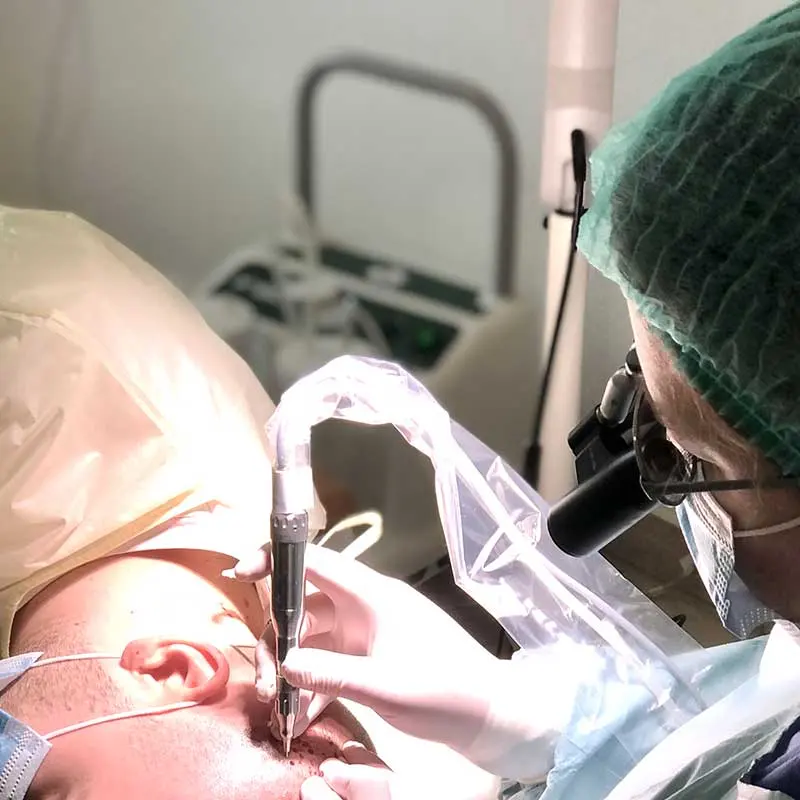
The procedure
What FUE actually is
FUE — follicular unit excision — is a considerably less invasive alternative to the older strip-harvest operations. There is no scalpel, there are no staples and no sutures, which is why FUE is more accurately called a procedure than an operation.
In FUE the individual follicular units, the grafts, are removed from the donor area one by one with a punch smaller than 0.8–0.9 mm. The technique allows up to around 2,000 grafts to be harvested in a day, either with the donor area shaved or, in some cases, without shaving it.
The result is decided by surgical technique: how the grafts are harvested, how they are stored between excision and placement, and the angle and depth at which they are implanted.
- The planned density is reached in a single procedure.
- No micropigmentation or hair tattooing is involved.
- No second density-filling operation over an area already transplanted.
- A microsurgical procedure, without damaging the donor area.
How it works
The path of a graft, step by step
FUE is how grafts are taken out; DHI is how they are put back. The two are not the same thing, and together they produce the result.
The safe donor area
Grafts come from the back and sides of the head, the zone that is not sensitive to androgenetic hair loss. How large an area is used depends on the number of grafts needed and on local conditions — careful planning is what keeps the donor area from looking visibly thinner afterwards.
Harvesting grafts one at a time
Follicular units are removed individually with a punch under 0.8–0.9 mm. No scalpel, no sutures, no horizontal scar at the nape. Harvested grafts are held in a chilled, specialist storage solution until implantation, which protects them from drying out.
DHI placement in the recipient area
Grafts are placed into the scalp with an implanter pen, without cutting recipient sites first. The angle and direction of each hair therefore follows natural growth, and existing follicles are not damaged — this is what produces a dense, natural hairline.
In section
What happens below the surface
Three cross-sections through the scalp, drawn to the same scale. Together they show why the angle a follicle grows at governs both how it is taken and how it is placed.
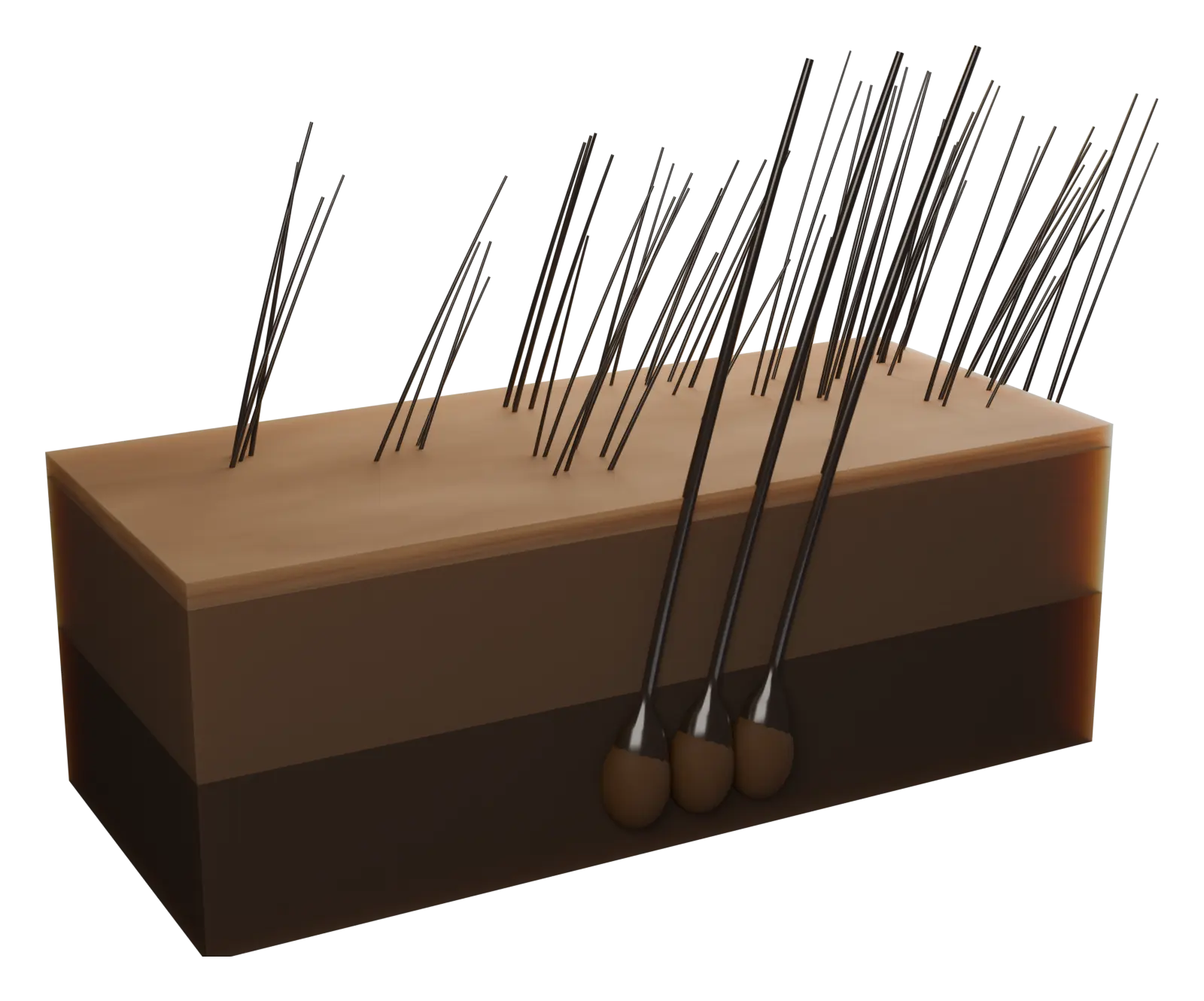
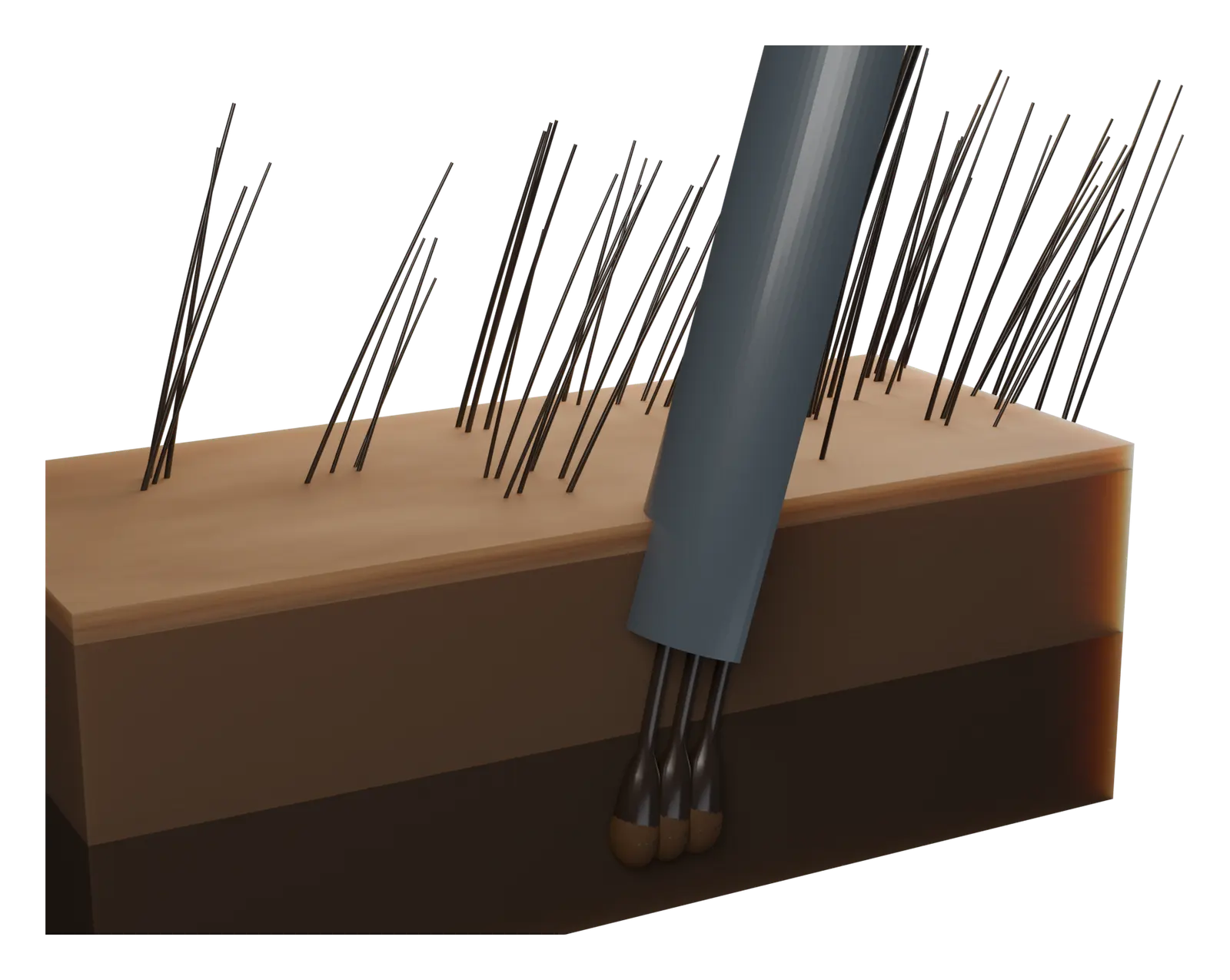
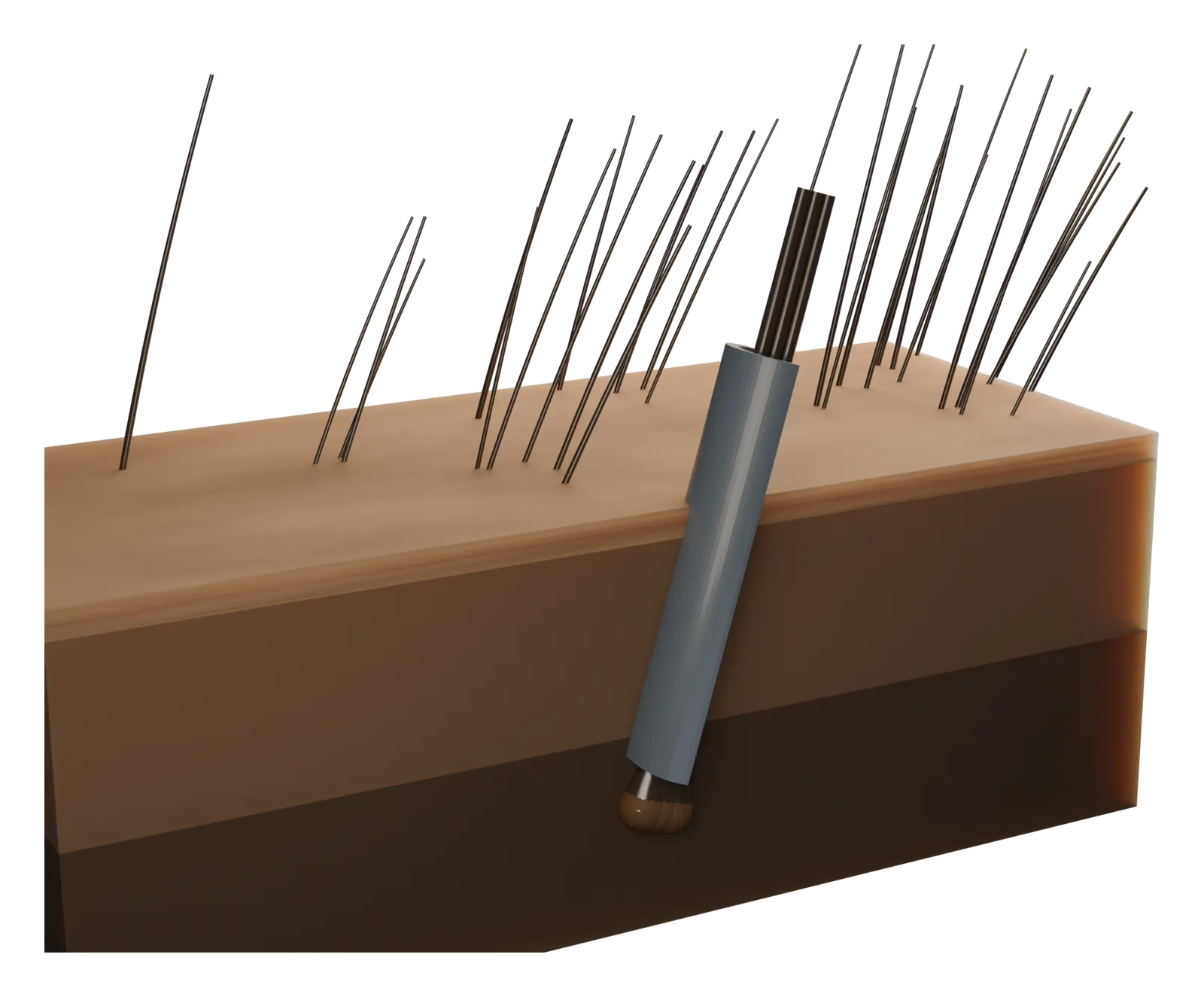
Rendered cross-sections, not photographs. The hairs are drawn thicker than life so the structures stay legible at this scale; the depths, the punch bore and the angles are to scale.
Instruments
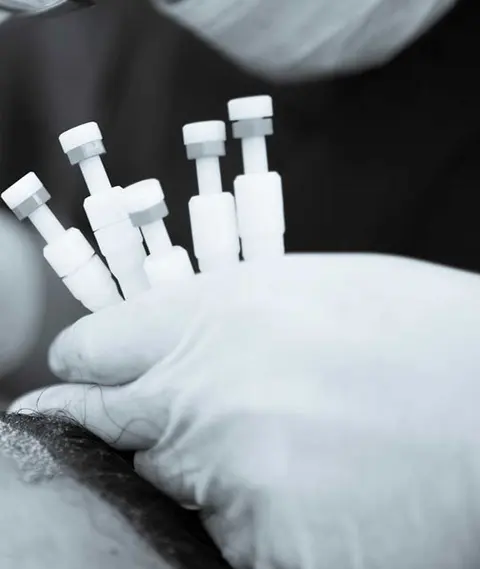
Trivellini Tech — Long Hair FUE
In 2019 I was the first in Hungary to begin working with the MAMBA system developed by Dr Roberto Trivellini, which has since become widely known and widely used. I also teach colleagues from abroad how to use it.
The Trivellini Tech MAMBA works with several settings and their combinations, which makes it suitable for transplanting curly hair — a contraindication for earlier FUE methods.
The MAMBA counts during surgery, but what it counts is punch actuations rather than grafts removed: it registers a count when a graft is scored, when the punch is cleaned, and when the suction function is used. The number on the display therefore does not represent the quantity of grafts harvested, though it does help keep the operation to plan and to time.

Technique
DHI — direct hair implantation
DHI, direct hair implantation, is a technique for placing harvested grafts. Once a graft has been taken, it is implanted into the scalp immediately with a purpose-made implanter pen, with no recipient site cut in advance.
It is not really correct to speak of FUE and DHI as two kinds of transplant, because they describe different stages: FUE is the method of extraction, DHI is the technique used to place the extracted grafts.
The advantage is a finer, denser hairline built without damaging existing follicles. The disadvantage is cost: DHI implanters cannot be reused, so every operation uses new ones.
Modern FUE techniques
Three routes to the same result
Which technique suits you is decided by your circumstances and the number of grafts required. The difference lies in how much shaving is involved and in the length of the operation — in all three the outcome is a natural hairline.
Shaven FUE
In traditional FUE the head is fully shaved on the day of surgery. This allows a larger number of grafts to be transplanted, makes denser coverage achievable and shortens the operation. 860 Ft per graft.
Partially shaven FUE
In partially shaven FUE the grafts are implanted into long hair. The donor area is shaped so that the shaved section can be covered by the surrounding hair. 1,065 Ft per graft.
Long Hair FUE
In long hair FUE neither the donor area nor the recipient area is shaved. Long hair is harvested and long hair is implanted. 1,720 Ft per graft.
What to expect
Healing and appearance
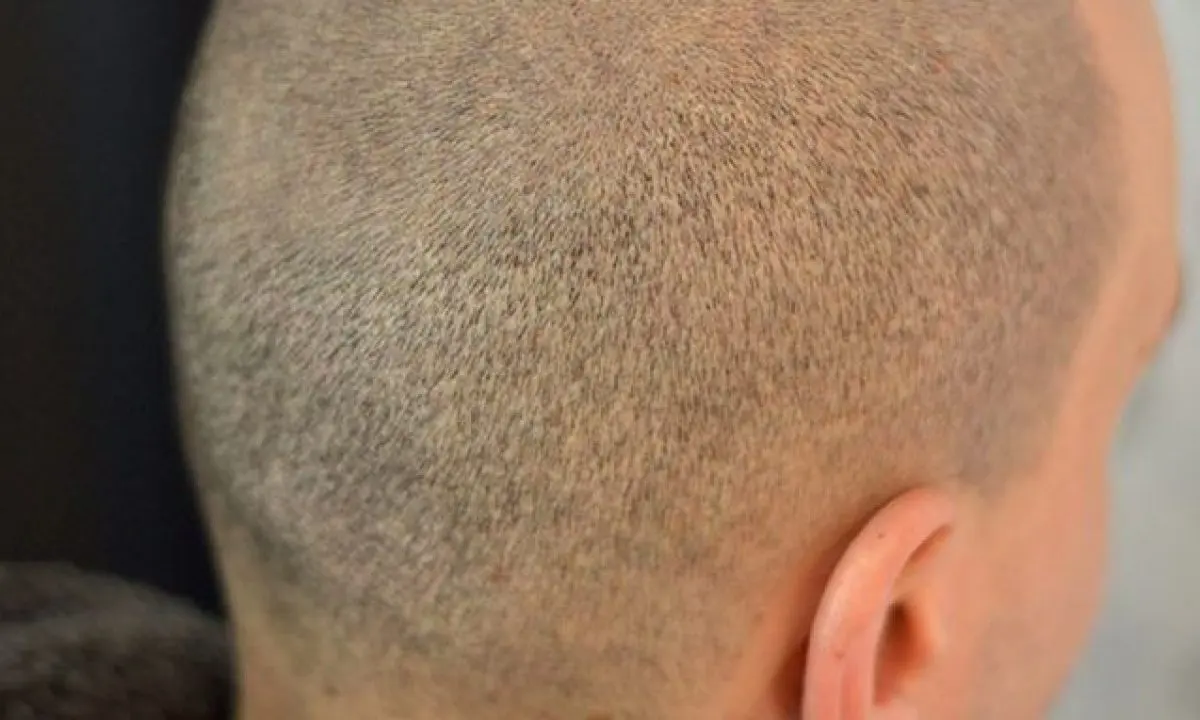
FUE is not scar-free, but with current technique the procedure leaves no visible trace even in short hair.
The donor area, where the grafts were taken from, regenerates without a visible mark within 7 to 10 days of treatment.
Placement is planned individually for each patient, following the angle and direction in which their own hair grows.
The procedure is not painful, during or afterwards, and you can travel home directly after the transplant.
Frequently asked
Questions patients ask most
Is a FUE hair transplant painful?
The procedure is carried out under local anaesthetic. Patients feel the injection of the anaesthetic itself; after that the donor and recipient areas are numb. Most people read, watch something or sleep during the day. Afterwards, mild tenderness is usual for a few days and is managed with ordinary painkillers.
How long do FUE results last?
Grafts are taken from the safe donor zone, which is not sensitive to dihydrotestosterone. Transplanted hair keeps that property, so it is permanent. Hair that was not transplanted can continue to thin, which is why a long-term plan often pairs a transplant with a hair-retention treatment.
How many grafts will I need?
That is what the trichoscopic examination establishes. The number depends on the size of the area to be covered, the density you start from, the capacity of the donor area and the thickness of your hair. It is not possible to give a reliable figure from a photograph.
How long does the procedure take?
A full day, typically eight to ten hours including breaks. The precise length depends on the number of grafts and on the technique — a fully shaven procedure is faster than a long hair FUE.
When will I see the result?
Transplanted hairs shed in the first weeks; this is expected and is not a loss of the graft. New growth generally begins from the third month, is clearly visible by the sixth, and reaches its final density at around twelve months.
Price
What the hair transplant price includes
These prices apply from 1 February 2026. We reserve the right to change them.
All prices are gross and include 27% Hungarian VAT.
Euro prices are indicative; billing is in Hungarian forint.
Health funds
The clinic has agreements with the following Hungarian health funds:
- — Patika Egészségpénztár
- — Új Pillér Egészségpénztár
- — MBH Gondoskodás Egészségpénztár
- — OTP Egészségpénztár
Consultation and diagnostics
Hair-retention treatments
Hair transplant
Medical consultation
Booking an appointment
Nothing meaningful can be said about treatment before an examination. At the consultation we assess the condition of the scalp, and recommend a treatment based on what we find — or recommend starting nothing for the time being.
What the consultation covers
- general medical examination
- assessment of your health status
- review of your blood test results
- camera examination of the scalp (trichological assessment)
- a written treatment plan
Contact
- Phone
- +36 70 408 1068
- [email protected]
- Clinic
- 1036 Budapest, Bécsi út 57-61.
- Opening hours
- Monday – Friday: 10:00 – 18:00
If you cannot attend a booked appointment, please let us know in good time. Appointments can be changed or cancelled free of charge only up to 48 hours before the booked time.