Female hair loss
Hair transplant for women
Hair loss in women follows a different pattern from men's, has a wider range of causes, and frequently responds to treatment that is not surgery at all. Which is why the examination comes first.
The difference
Why it is not the same problem
Male pattern loss recedes at the temples and thins at the crown, leaving the donor area at the back untouched. Female pattern loss usually does something different: it thins diffusely across the top while the frontal hairline stays where it is.
That difference matters for what can be done. A woman with diffuse thinning may have no sharply defined bald area to transplant into, and the density of the donor area may itself be reduced — which changes what a transplant can realistically achieve.
It also matters for diagnosis. Diffuse thinning in a woman has a much longer list of possible causes than the same complaint in a man, and several of them are reversible without any surgery.
Causes
What the examination is looking for
These are the findings that change the answer. Several of them are treated medically, not surgically, and a transplant carried out without ruling them out first will disappoint.
Female pattern hair loss
The androgenetic form, graded on the Ludwig scale rather than the Norwood. Diffuse thinning over the top of the scalp, generally with the frontal hairline preserved. This is the form a transplant can address.
Telogen effluvium
A diffuse shed following childbirth, illness, surgery, significant weight loss or severe stress, typically two to four months after the event. It usually recovers on its own, and surgery during it is the wrong answer.
Iron deficiency and thyroid disorder
Low ferritin and thyroid dysfunction both cause diffuse hair loss and are found on a blood test. Both are treatable, which is why blood results are part of the consultation.
Traction alopecia
Loss along the hairline and temples from prolonged tension — tight braids, extensions, weaves, or a tightly pulled-back style worn for years. If the follicle is scarred the hair does not return, and this is one of the clearest indications for a transplant in women.
Hormonal causes
Polycystic ovary syndrome, the perimenopausal transition and some contraceptives all affect hair. These are managed with the relevant specialist, not in a surgical clinic.
Scarring alopecias
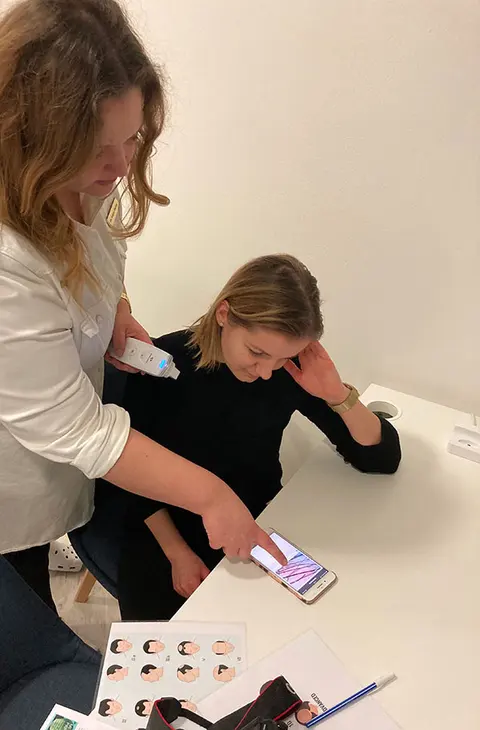
Frontal fibrosing alopecia and lichen planopilaris destroy the follicle and are usually a contraindication to transplanting while the condition is active. Recognising them is one of the more important things trichoscopy does.
The honest answer
When a transplant is not the right treatment
A substantial share of the women who come to a hair clinic should not have surgery — at least not first. Where the loss is a telogen effluvium, or driven by low ferritin, thyroid disease or a hormonal cause, treating that cause is what restores the hair, and an operation would not.
Where the pattern is androgenetic but the donor area is itself thinning, a transplant moves hair from one thin area to another. The trichoscopic measurement of donor density is what settles that question, and it is measured rather than estimated.
Where a scarring alopecia is active, transplanting into it risks losing the grafts to the same process.
If the examination points to any of these, we will say so. That is the point of examining first.
This is also why the consultation includes a review of your blood results. If you have recent ferritin, thyroid and hormone tests, bring them; if not, they may be what the consultation asks for next.
When it is
What a transplant does well in women
Where the indication is right, the results are the same permanent, own-hair results as in men. Three situations account for most of them.
Scars — from a facelift, a brow lift or an injury — are also treated this way, with grafts placed into and around the scar to break up its line.
- A hairline that has receded or was always high, where the frontal line is lowered or reshaped and the temporal points rebuilt.
- Traction alopecia, where the tension has stopped and the loss is settled, but the follicles along the old hairline are gone.
- Female pattern thinning with a donor area that has kept its density, where grafts add coverage to the central part.
Without shaving
Long Hair FUE, and why it matters here
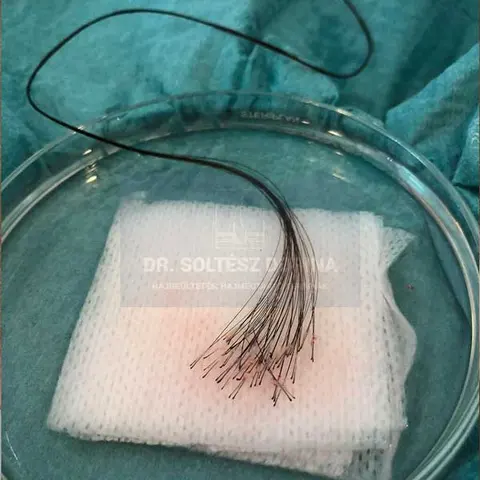
The prospect of a shaved head is what stops many women having a transplant at all. Long Hair FUE avoids it: neither the donor area nor the recipient area is shaved, long hair is harvested and long hair is implanted, and the result is covered by your own hair from the first day.
The technique is slower and costs more per graft than a shaven procedure, and it moves fewer grafts in a day. For a woman who does not want a visible recovery, that trade is usually the one worth making — and it is the reason the technique features as heavily here as it does.
Whether it suits your case depends on the area to be covered and on your hair itself, and is decided at the consultation.
Frequently asked
Questions women ask
Will my head have to be shaved?
Not necessarily. Long Hair FUE shaves neither the donor nor the recipient area, so nothing is visible afterwards. It is slower and costs more per graft, and it moves fewer grafts in a day than a shaven procedure — which of the techniques suits your case is settled at the consultation.
Is hair loss in women treated differently from men?
The surgery itself is the same procedure. What differs is the diagnosis: diffuse thinning in a woman has a much wider range of causes, several of them reversible, so more of the consultation goes on establishing which one you have. It also differs in planning, because a preserved frontal hairline and diffuse thinning behind it call for a different distribution of grafts.
Can I have a transplant if my hair is thinning all over?
It depends on the donor area. If the back and sides have kept their density, grafts can be added to the thinner areas. If the donor area is itself thinning — which happens in female pattern loss and in some scarring conditions — a transplant would move hair from one thin area to another. Trichoscopy measures donor density, so this is answered with a number rather than an opinion.
My hair started falling out after having a baby. Should I book a transplant?
Almost certainly not yet. A diffuse shed two to four months after childbirth is usually postpartum telogen effluvium, which recovers on its own over several months. Surgery during it is the wrong treatment. If the hair has not recovered after a year, that is the point to have it examined.
Does a female surgeon make a difference?
Not to the technique. It can make a difference to the consultation, in that hair loss in women is frequently dismissed or dealt with briskly elsewhere, and a longer conversation about how you actually wear your hair is part of planning a hairline that will suit it.
How many sessions will I need?
Most cases are planned as a single procedure. What determines the number is the area to be covered and the capacity of the donor area, both of which are measured at the examination rather than estimated beforehand.
Medical consultation
Booking an appointment
Nothing meaningful can be said about treatment before an examination. At the consultation we assess the condition of the scalp, and recommend a treatment based on what we find — or recommend starting nothing for the time being.
What the consultation covers
- general medical examination
- assessment of your health status
- review of your blood test results
- camera examination of the scalp (trichological assessment)
- a written treatment plan
Contact
- Phone
- +36 70 408 1068
- [email protected]
- Clinic
- 1036 Budapest, Bécsi út 57-61.
- Opening hours
- Monday – Friday: 10:00 – 18:00
If you cannot attend a booked appointment, please let us know in good time. Appointments can be changed or cancelled free of charge only up to 48 hours before the booked time.