FAQ
Hair transplant — frequently asked questions
People considering a hair transplant tend to have a great many questions. These are the ones that come up most often.
FAQ
Hair transplant — frequently asked questions
How does FUE work?
FUE, follicular unit excision, is a hair transplant procedure in which the grafts are removed from the donor area one at a time. A graft is the biological unit containing the follicles and the hairs they grow; grafts generally hold one to four hairs and are taken from the donor area, which is not sensitive to androgenetic hair loss. FUE can be carried out by manual, motorised or automated means. Which is used depends on the characteristics of the follicles — hair thickness, curl, exit angle and so on.
Are there several kinds of FUE procedure?
The short answer is no. Whatever names are used, there are not several different FUE procedures. As above, the punch — mechanical, electrical or robotic — and the type and diameter of the punch tip are chosen according to the patient, but none of this changes the essence of the procedure. It is the same FUE technique throughout.
What are the advantages of FUE?
Considerably less discomfort or pain after surgery.
No horizontal scar at the nape of the neck.
The surgical wounds are far smaller and less conspicuous, and heal within days.
Harvesting grafts individually makes it possible to take donor hair from areas that traditional methods could not reach, such as the zones at the side of the scalp, and from the beard or body hair.
What are the disadvantages of FUE?
The number of grafts that can be harvested and placed in one day is limited. Some cases require two days of surgery.
The success of FUE depends heavily on the operating physician, the technique used and the materials. Good hand-eye coordination is needed both for harvesting and for implantation.
FUE grafts are considerably more fragile, so particular care is required throughout. Inadequate expertise or technique, or an operation that runs too long, causes trauma, and graft survival can fall a long way — below 50 to 60 per cent — which produces an insufficiently dense, unnatural result. The consequence is that an already transplanted area has to be transplanted again to reach natural density.
Avoiding that trauma is the greatest challenge in carrying out FUE hair transplants.
Does FUE leave a visible scar?
A number of tiny, dot-like wounds form in the donor area after the procedure. These close within two to four days. The microscopic scars that remain are difficult or impossible to see.
What does a hair transplant cost?
No two cases are alike, so no fixed template can produce a figure. The price is affected by many factors, including the number of grafts required, where the donor hair is taken from, and the desired result and density. The cost is higher with the unshaven NON-SHAVE and the LONG HAIR FUE techniques.
How long is the recovery after a FUE hair transplant?
Most patients can return to their usual routine two to seven days after surgery. FUE wounds generally close within two to four days, though it can take seven to ten days for the donor area to be free of crusting.
Is a FUE hair transplant painful?
Typically patients have no pain either during or after the procedure. Only a few report mild pain after FUE, which resolves with a painkiller. In most cases no pain occurs at all.
Will my forehead swell after a FUE hair transplant?
With modern anaesthetic and surgical technique, the likelihood of swelling or oedema forming on the forehead is dramatically lower than with older methods. In the majority of operations oedema does not occur.
How many grafts will I need?
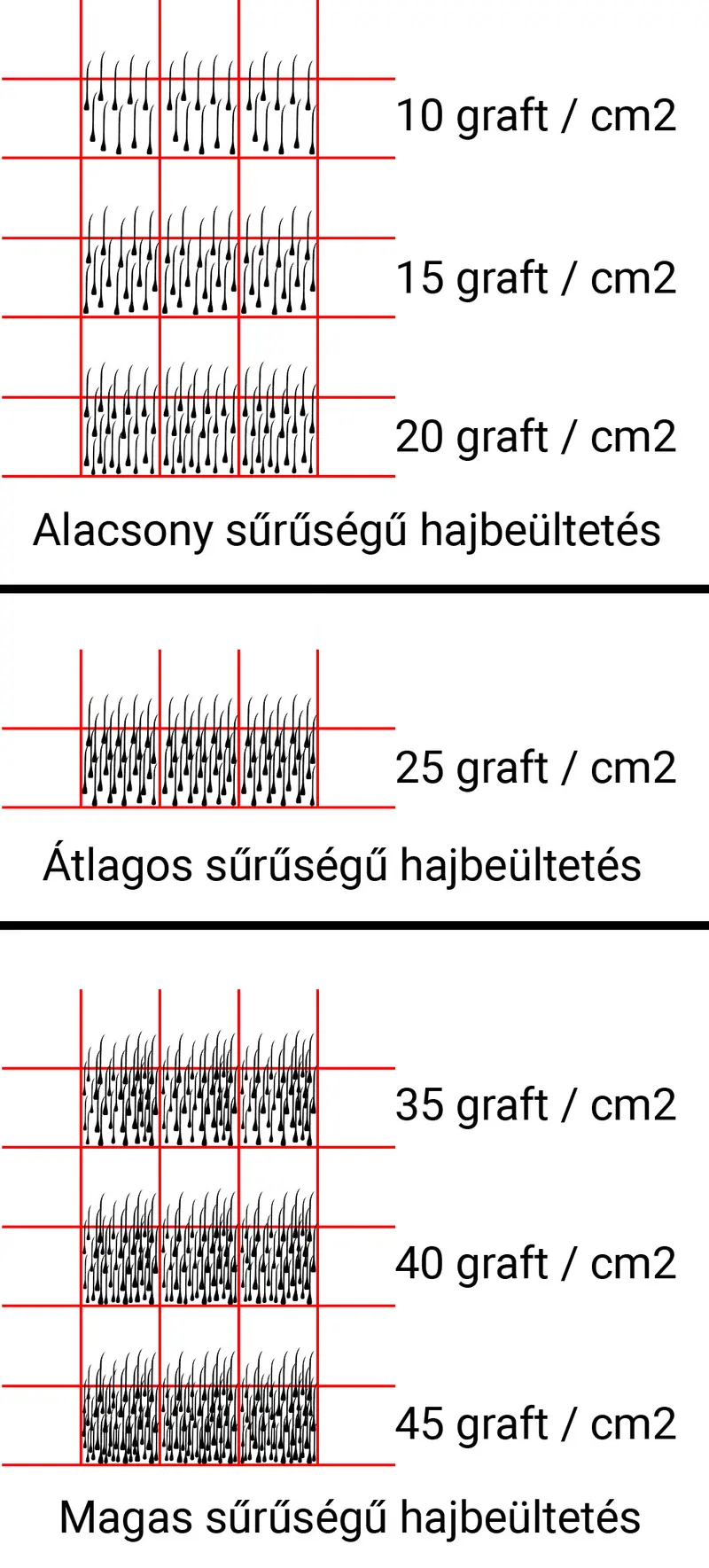
The number of grafts needed depends on the size of the area to be covered and the density wanted. Thicker grafts, and grafts carrying more hairs, produce fuller, denser hair — and that is genetically predetermined. At the first consultation we go through your goals and what is possible before establishing the number of grafts required.
How long do FUE results last?
The results of a FUE hair transplant last a lifetime, provided the grafts are taken from the safe zone and surgical trauma is kept to a minimum.
Do FUE results look natural?
When the procedure is carried out by an experienced and competent physician using the right technique, the result looks natural and others cannot tell that the patient has had a hair transplant. To see results before and after a transplant, visit the before-and-after page, where the most recent results from actual patients are shown.
How long does a FUE hair transplant take?
The length of the procedure depends on the planned number of grafts and on the type of FUE. Generally it takes four to eight hours. Where more than 2,000 to 2,500 grafts are required, surgery takes two days. In particular cases a transplant can be performed without shaving the hair, but LONG HAIR FUE is more time-consuming: generally no more than 500 to 1,000 grafts can be safely transplanted in one surgical day with that technique.
What is the difference between FUE and DHI?
These are two different concepts. FUE refers to the technique of harvesting hair graft by graft, which can be done manually or with a powered instrument — it is the process of removing grafts from the donor area. DHI, or Direct Hair Implant, is a technique for placing the harvested grafts: immediately after extraction they are implanted into the scalp with a special implanter pen, without cutting a recipient site in advance. It is not really possible to speak of FUE and DHI transplants as alternatives, because they do not mean the same thing. After FUE extraction the grafts can be placed using the DHI technique, and so can grafts from a FUT extraction. The confusion usually arises because FUE is taken to describe not only the extraction but the whole operation, with the assumption that sites must be cut for the grafts after extraction. Since the two terms describe different stages of a hair transplant, the question in that form does not really stand.
What are the risks and complications of a FUE hair transplant?
Complications of FUE can include swelling, bruising, itching and pain. There is also a risk of bleeding and of numbness of the scalp. One notable risk is shock loss, meaning hair loss after surgery. This can be greatly reduced if patients follow the advice of the physician carrying out the transplant.
Does the newly transplanted hair grow straight away?
No. The transplanted hairs shed within the first weeks, which is expected and does not mean the graft has been lost. The follicle remains in place and begins producing new hair from around the third month.
When will the final result be visible?
New growth generally begins from the third month and is clearly visible by the sixth. The final density is reached at around twelve months, and in some cases up to eighteen.
What do I need to do after the procedure?
Patients are given instructions on caring for the hair and on what is recommended for the best result. You should sleep in a semi-upright position, at a 45-degree angle, to keep swelling to a minimum. Patients are given a neck pillow for the night, which prevents the transplanted hairs from being accidentally rubbed or pulled out during sleep. Normal daily activity can resume after the fourth day, but strenuous exercise must be avoided for a full week after the transplant.
Medical consultation
Booking an appointment
Nothing meaningful can be said about treatment before an examination. At the consultation we assess the condition of the scalp, and recommend a treatment based on what we find — or recommend starting nothing for the time being.
What the consultation covers
- general medical examination
- assessment of your health status
- review of your blood test results
- camera examination of the scalp (trichological assessment)
- a written treatment plan
Contact
- Phone
- +36 70 408 1068
- [email protected]
- Clinic
- 1036 Budapest, Bécsi út 57-61.
- Opening hours
- Monday – Friday: 10:00 – 18:00
If you cannot attend a booked appointment, please let us know in good time. Appointments can be changed or cancelled free of charge only up to 48 hours before the booked time.